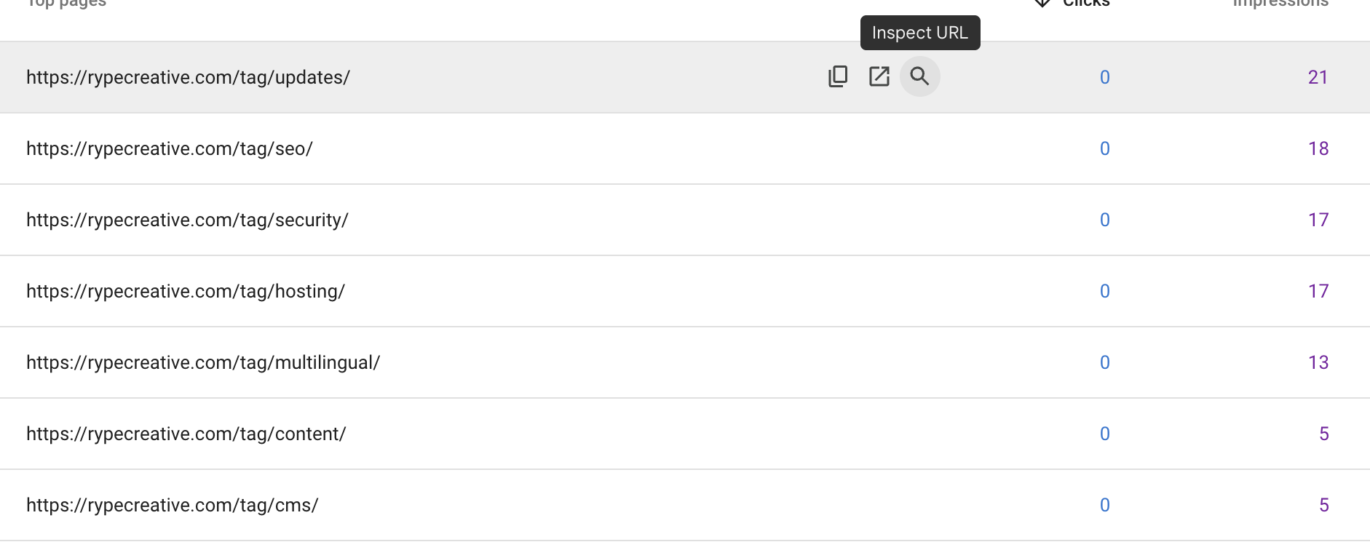
Tag pages in WordPress sit in an unusual position. They are automatically generated, rarely designed with intent, and often treated as an SEO problem by default. It’s common advice to simply noindex all tags—a quick fix that seems safe and widely accepted. But in practice, the situation is more nuanced.
Google does not treat tag pages as inherently low-quality. It evaluates them the same way it evaluates any other archive or listing page: based on structure, content depth, and usefulness. Some tag pages are ignored. Others get indexed. A few even rank. Understanding why this happens is more valuable than following blanket recommendations.
What Are Tag Pages in WordPress (Technically)
In WordPress, tag pages are part of the taxonomy system—specifically, non-hierarchical taxonomy archives. Each tag you assign to a post automatically generates a dedicated archive page, typically structured as:
/tag/tag-name/
These pages aggregate all posts associated with a given tag and display them in a chronological or paginated format.
From a technical standpoint, a tag page is not fundamentally different from:
- a category archive
- an author archive
- or even a product listing page in ecommerce
It is a dynamically generated listing page with a defined query and template.
The distinction between categories and tags is often misunderstood. Categories are hierarchical and usually represent the primary structure of the site. Tags, on the other hand, are flat and more flexible—they can be used to describe topics, themes, or attributes across content.
In practice, this flexibility leads to two very different outcomes.
Used strategically, tags can act as connectors between related pieces of content, forming thematic clusters. Used without control, they quickly become fragmented, overlapping, and difficult to manage.
For search engines, however, the origin of the page does not matter. Google does not “see” a tag—it sees a URL with a list of links. The question is not whether it is a tag page, but whether that page provides value as an entry point into the site.
That distinction becomes critical when we look at how Google decides what to index.
How Google Sees Tag Pages
From Google’s perspective, a tag page is not a special type of content. It is treated as a listing page—a collection of links grouped around a theme.
This places tag pages in the same category as:
- category archives
- blog index pages
- ecommerce category listings
They are evaluated based on their usefulness as navigation and discovery points, not on whether they were generated by a specific CMS feature.
Tag Pages as Archive Pages
A typical tag page contains:
- a list of posts
- links to individual articles
- pagination
- sometimes a short description
In essence, it functions as a curated entry point into a topic.
If the grouping makes sense and helps users explore related content, Google can treat it as valuable. If the grouping is arbitrary or thin, it is likely to be ignored.
This is why two tag pages on the same site can be treated completely differently—one indexed and ranking, another crawled but excluded.
Crawling vs Indexing
A critical distinction is often overlooked: Google crawling a page does not mean it will index it.
In many real-world cases, tag pages fall into one of the following states in Search Console:
- Discovered – currently not indexed
- Crawled – not indexed
This behavior is not an error. It is a filtering mechanism.
Google explores these pages to understand site structure and content relationships, but only includes a subset of them in the index—those that demonstrate sufficient value.
The implication is straightforward:
Tag pages are not penalized—they are selectively promoted.
Understanding what drives that selection requires looking at actual patterns across different types of websites.
Real-World Indexing Patterns
In practice, Google’s treatment of tag pages follows recognizable patterns. These patterns are not documented explicitly—but they are consistent across different types of websites.
Small Blogs
On smaller sites, tag pages are rarely indexed.
This is typically due to limited content depth. Many tags end up containing only one or two posts, often overlapping in meaning. From Google’s perspective, these pages do not offer anything beyond what individual articles already provide.
As a result, they are usually crawled occasionally, excluded from the index, or never fully processed.
In Search Console, this often appears as “Discovered – currently not indexed” or “Crawled – not indexed.”
The issue here is not the presence of tags—but the lack of substance behind them.
Large Content Sites
On larger blogs and media platforms, the situation changes.
When a tag represents a clear, well-defined topic and aggregates a meaningful number of posts, it can function as a thematic entry point. In such cases, Google is more likely to index the page—and in some cases, allow it to rank.
These tag pages often:
- group 10, 20, or more related articles
- target mid-tail or topic-level queries
- serve as navigational hubs for users
Here, the tag page begins to resemble a category page in function, even if not in structure.
SEO-Driven Tag Strategies
In more mature setups, tags are used intentionally as part of content architecture.
Instead of being assigned casually, they are:
- limited in number
- aligned with key topics
- supported by internal linking
Some sites go further by adding introductory content to tag pages, improving metadata, and ensuring consistency across the taxonomy.
In these cases, tag pages are not just indexed—they can perform competitively in search results. They act as lightweight content hubs, capturing traffic for broader queries while distributing authority to individual articles.
Across all three scenarios, the pattern is consistent:
Tag pages are indexed when they behave like useful aggregations of content, and ignored when they behave like thin, redundant listings.
Understanding what drives that distinction requires a closer look at the underlying factors.
Key Factors That Determine Indexing
Google does not index tag pages randomly. The decision is driven by a set of consistent signals—most of which relate to value, clarity, and efficiency.
The first and most visible factor is content depth.
A tag page that aggregates a meaningful number of posts has a higher chance of being indexed. When a page brings together 10 or more relevant articles, it starts to function as a topic overview rather than a thin listing. In contrast, tags with only one or two posts rarely justify their existence as standalone pages. In such cases, Google typically ignores them.
Closely related to this is topical clarity.
If a tag represents a clearly defined concept—something users might actually search for—it becomes easier for Google to understand its purpose. But when tags overlap, duplicate each other, or differ only slightly in wording, they create ambiguity. Multiple pages end up competing for the same semantic space, and Google resolves this by selecting one—or ignoring all of them.
Another important factor is internal linking.
Tag pages that are actively integrated into the site structure send stronger signals. When they are linked from articles, navigation elements, or related content sections, they gain visibility—not just for users, but for search engines. Pages that exist in isolation, even if technically accessible, are far less likely to be prioritized.
There is also the question of crawl efficiency.
On larger sites, the number of tag pages can grow rapidly. If each post generates multiple loosely defined tags, the total number of archive pages can exceed the site’s ability to support them. Google responds by allocating crawl resources selectively, focusing on pages that appear more valuable and skipping the rest.
Finally, there are engagement signals, even if indirect.
If users interact with tag pages—navigate deeper, click through to articles, spend time exploring—the page is more likely to be retained in the index. If it serves no real purpose beyond listing links, it becomes expendable.
Taken together, these factors point to a simple principle:
Google indexes tag pages not because they exist, but because they function as meaningful entry points into content.
Summary of Key Signals
| Factor | Positive Signal | Negative Signal |
|---|---|---|
| Content depth | Many relevant posts grouped | 1–2 posts only |
| Topical clarity | Clear, distinct topic | Overlapping or duplicate tags |
| Internal linking | Integrated into site structure | Isolated, rarely linked |
| Crawl efficiency | Limited, curated tags | Tag proliferation / clutter |
| User engagement | Clicks, navigation, time on page | No interaction value |
Should You Noindex Tag Pages?
This is where most discussions around tag pages usually begin—and often end. The common recommendation is simple: noindex all tag pages and move on.
In practice, this approach is convenient—but not always correct.
The decision to index or noindex tag pages should not be universal. It should be based on how those pages function within your site.
When tag pages are created without structure—too many tags, minimal content per tag, overlapping topics—they rarely provide value. In such cases, noindexing them is a reasonable step. It reduces crawl waste and prevents low-quality pages from competing with more important content.
However, the opposite scenario is just as common on more mature websites.
When tags are used intentionally—aligned with real topics, supported by multiple articles, and integrated into internal linking—they can act as lightweight content hubs. These pages help users navigate related content and can capture search demand for broader or mid-tail queries.
In these cases, noindexing them removes potential entry points into the site.
The most effective approach in practice is selective.
High-value tag pages—those with clear purpose and sufficient depth—should remain indexable. Low-value or redundant ones can be excluded. This allows you to preserve crawl efficiency while still benefiting from the structural advantages of tags.
The key is not the tag itself, but how it is used.
Blanket noindex rules simplify management, but they also eliminate opportunity. A more deliberate approach requires effort—but aligns better with how Google actually evaluates pages.
Common Mistakes
Most issues with tag pages do not come from how Google treats them—but from how they are implemented.
One of the most common mistakes is creating too many tags without a clear purpose. In many WordPress setups, tags are added spontaneously during content creation. Over time, this leads to dozens—or hundreds—of loosely defined labels, many of which are used only once. Instead of forming meaningful clusters, they fragment the content structure.
A related problem is treating tags as keywords.
Tags are often assigned based on SEO intuition rather than content relationships. Slight variations of the same concept—singular vs plural, synonyms, or reordered phrases—result in multiple tag pages competing for the same topic. From Google’s perspective, this creates redundancy rather than relevance.
Another frequent issue is overlap between tags and categories.
When tags duplicate the role of categories, the site ends up with multiple archive pages targeting the same theme. This dilutes signals and makes it harder for search engines to determine which page should be prioritized.
There is also a tendency to apply blanket rules without analysis.
Noindexing all tag pages is a common example. While it simplifies management, it ignores the fact that some tag pages may already be indexed, ranking, or contributing to internal linking. Removing them from the index without evaluating their performance can lead to unintended losses.
Finally, many sites simply ignore tag pages altogether.
They exist, but they are not reviewed, optimized, or integrated into the broader content strategy. No titles are refined, no descriptions are added, and no effort is made to improve their structure. In this state, tag pages are unlikely to provide value—to users or to search engines.
In most cases, the problem is not that tag pages exist. It is that they are left unmanaged.
When treated as part of the site architecture rather than an afterthought, they can support both navigation and SEO. When neglected, they become noise.
Tag Pages vs Categories (SEO Role)
Although tag pages and category pages are both taxonomy archives in WordPress, they serve fundamentally different roles—and confusing them is one of the main reasons sites develop structural SEO issues.
Categories define the primary architecture of a website. They are hierarchical, stable, and typically aligned with core topics or business areas. From Google’s perspective, category pages often function as key entry points. They tend to carry stronger signals, attract more internal links, and are more likely to rank for broader, high-level queries.
Tag pages, by contrast, operate on a secondary level.
They are not meant to structure the site—they are meant to connect content across structures. A well-used tag can link articles from different categories under a shared theme, creating a horizontal layer of navigation. This is where their real value lies.
In practice, the distinction can be summarized simply:
- categories organize
- tags associate
Problems begin when tags attempt to replace categories—or mirror them too closely. When both taxonomies target the same topics, the site ends up with duplicate archive pages competing for visibility. This weakens overall structure and forces search engines to choose between similar URLs.
Used correctly, however, the two complement each other.
Categories establish the backbone of the site. Tags extend that structure by forming semantic connections between related pieces of content. Together, they create a more navigable and understandable system—for both users and search engines.
Stop Noindexing Tags Blindly
Google does not treat WordPress tag pages as inherently low-quality. It evaluates them based on the same criteria as any other page: usefulness, structure, and relevance.
Tag pages are indexed when they:
- group meaningful content
- represent clear topics
- support navigation and discovery
They are ignored when they:
- lack depth
- duplicate other pages
- add no real value
The common practice of noindexing all tag pages simplifies management—but overlooks their potential role in content architecture.
In reality, tag pages are neither a problem nor a solution by default. They are a tool. When used without structure, they create noise. When used intentionally, they can strengthen internal linking, improve topical coverage, and in some cases, even rank.
The difference lies not in how WordPress generates them—but in how you choose to use them.